
1. Sensor count and sensor range are separate decisions
Size each sensor for the minimum and maximum actual flow in its own line, while respecting the fuel system's allowable restrictions.
One sensor measures one line. A typical petrol engine without a return needs one; a diesel returning fuel to the tank needs two, for supply and return. Two such diesels need four. The circuit layout, not the fuel name alone, decides the measurement arrangement. Unusual circuits require confirmation of device compatibility.
Single, Duo, Diesel and Duo Diesel kits differ in contents and measurement method. First check sensor count and kit configuration, then size each FS-40.
2. Check both ends of the range, not just the maximum
For a typical petrol engine without a fuel return line, the engine-power bands shown in the shop are a practical starting point for sensor selection. Confirm the engine model and maximum fuel consumption. For a diesel with a return line, size each sensor for the minimum and maximum actual flow in its own line — supply and return separately — not engine power or net fuel burn alone.
| FS-40 version | Minimum | Maximum |
|---|---|---|
| S | 0.5 l/h | 20 l/h |
| M | 1 l/h | 40 l/h |
| L | 1.5 l/h | 90 l/h |
| XL | 2 l/h | 120 l/h |
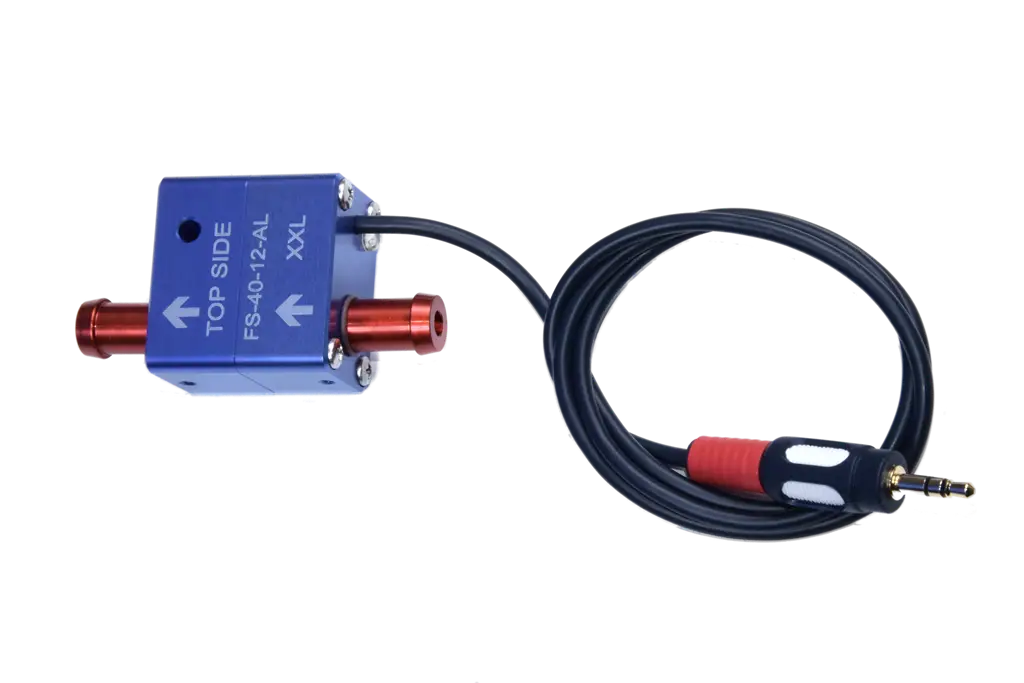
| XXL | 3 l/h | 180 l/h |
| 3XL | 5 l/h | 300 l/h |
S and M: hose with an 8 mm internal diameter. L, XL, XXL and 3XL: hose with a 10 mm internal diameter.
These are version-specific flow ranges, not engine-power ratings. An undersized sensor may exceed its range or cause excessive pressure drop. An oversized sensor may not register small flows. A larger hose connection is not a reason to choose a higher flow range.
Check conditions from idle to maximum load, including warm fuel. Allow for uncertainty and the margin agreed for the particular installation. A diesel requires data for both lines and confirmation of which sensor versions can work together with the selected interface.
3. Return-line diesel: why is the 2.5–3 × fuel-burn estimate not enough?
This estimate concerns diesel fuel circulation with a return line. Do not use it as a sensor-sizing multiplier for a typical petrol engine without a return line.
When gross-flow data are unavailable, one preliminary approach is to estimate the required upper range as roughly 2.5–3 × maximum fuel burn at full load (WOT). For 50 l/h, this gives 125–150 l/h. The Maretron sensor selection guide also uses this approach, but it does not confirm an FS-40 selection and is not a rule for every diesel.
Circulation depends on the pump, injection system, regulator and cooling needs. It can greatly exceed this estimate. Documented flow in the actual circuit takes priority. Maximum unloaded rpm is not a substitute for full-load data, and a pump's free-flow rating may not describe flow in the running engine.
4. Example: 50 l/h burnt does not mean 50 l/h in the supply
Suppose fuel burn is 50 l/h and return is 120 l/h at the same steady operating point. In a simplified volume balance, with comparable fuel temperatures, supply is 50 + 120 = 170 l/h. That exceeds the preliminary 125–150 l/h estimate.
170 l/h falls within the XXL range (3–180 l/h), but the arithmetic alone does not approve the selection. Confirm maximum flow across all operating conditions, minimum flows, restrictions and the required margin; the remaining 10 l/h is not a universal safety allowance. Check the return sensor separately too.
5. An old FloScan kit does not automatically identify the FS-40 size
Standard Flow, High Flow and FloScan kit numbers describe that manufacturer's equipment. They do not confirm a particular engine's actual flow or mechanical, electrical and measurement interchangeability with FS-40. Do not assume “Standard = XXL” or “High Flow = 3XL”.
3XL has an upper limit of 300 l/h; it does not cover every large circulation circuit. Older catalogues can refer to different engine, pump and kit versions. FloScan also describes high return flows and temperature compensation in its own systems. Those features do not automatically apply to Flowtrecs. Selection requires current circuit data, not just a row in a historical table.
6. What should you send to confirm the selection?
- Exact engine model and version, fuel type and engine count.
- A diagram including supply, return, regulator, bypasses and injector leak-off.
- Minimum and maximum operating flow in each line; full-load fuel burn listed separately, with the data source.
- Pump model, the conditions for its delivery rating, allowable supply restriction and return pressure.
- Hose internal diameter, fuel temperature and the Flowtrecs device and interface model.
If data are missing, have a service technician measure flow in a closed circuit using the engine manufacturer's procedure under representative operating conditions. Do not disconnect the return into an open container or carry out maximum-load tests yourself. Send the details for review before ordering. Installation is covered in the separate FS-40 guide.