
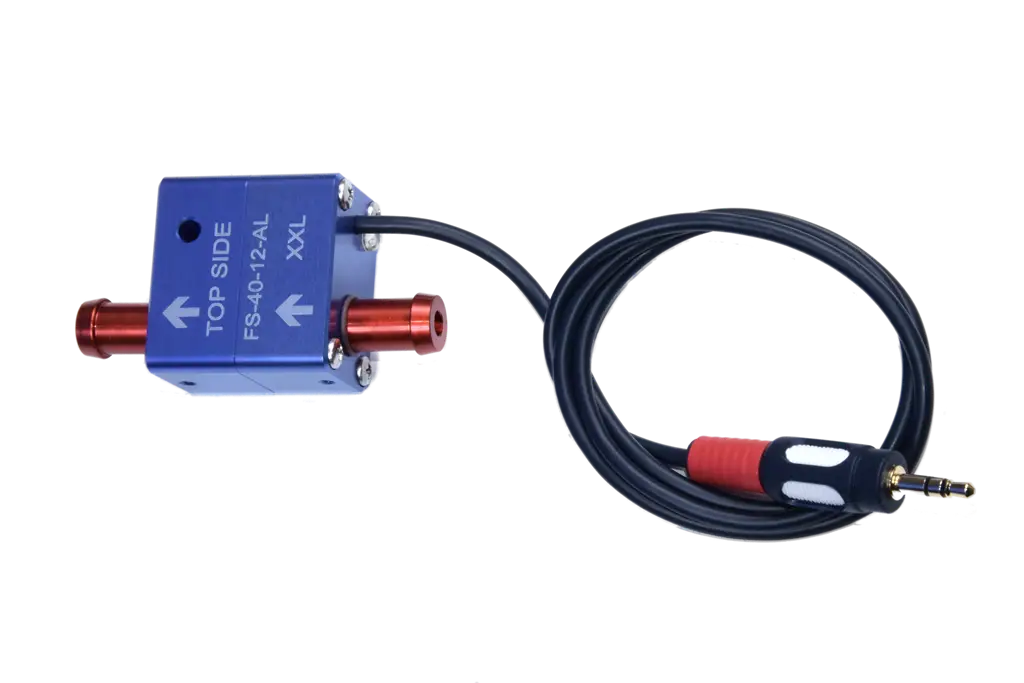
Quick answer: 1, 2 or 4 sensors?
One petrol engine without a fuel return normally uses one sensor. One diesel engine with a return line uses two: one in the feed and one in the return. With two engines, the number of measuring points doubles.
| Installation | FS-40 count | Measurement |
|---|---|---|
| 1 petrol engine without a return line | 1 | Feed-line flow |
| 2 petrol engines without a return line | 2 | One sensor per engine |
| 1 diesel engine with a return line | 2 | Feed minus return |
| 2 diesel engines with return lines | 4 | Two sensors per engine |
This matrix covers common installations. Verify the actual fuel-line layout before ordering: fuel type alone does not determine sensor count.
What actually determines sensor count?
Count the engines first, then check whether each engine sends excess fuel back to the tank through a separate return line. One FS-40 measures flow in one line. If all fuel passing through the feed line is consumed, one measuring point per engine is sufficient.
If some fuel returns to the tank, feed flow is not the same as consumption. A second sensor is needed in the return, together with a device that supports differential measurement. The useful question is therefore: how many independent lines must be measured?
Petrol engine without a return line
In a typical no-return installation, the feed-line sensor measures the fuel delivered to one engine. Two such engines require two independent sensors, one in each fuel circuit.
For one petrol engine without a return line, a single-channel Flowtrecs Inox or Flowtrecs Mini can be used. Two petrol engines without return lines require the appropriate two-channel variant of Wave, standard Android BT, C7 Ultra or App.
Diesel engine with a return line
In a return system, the pump may circulate more fuel than the engine burns. The first sensor measures feed flow, the second measures fuel returning to the tank, and a compatible computer calculates net consumption from the difference.
One engine of this type needs two sensors. Two engines need two separate pairs, for a total of four. The complete, practical guide to differential measurement and selection is diesel fuel measurement.
Which Flowtrecs supports each configuration?
| Product family | Sensor support | Typical use |
|---|---|---|
| Inox | Maximum 1 | 1 petrol engine without a return line; waterproof (IP65) |
| Mini | Maximum 1 | 1 petrol engine without a return line; splash-resistant (IP64) |
| Wave | 1, 2 or 4-sensor variants | 1–2 engines, including return-line diesel; waterproof (IP68) |
| Android BT | 1, 2 or 4-sensor variants | 7-inch Android 6 panel; not waterproof, enclosed boats only |
| C7 Ultra | 1, 2 or 4-sensor variants | Android 12, waterproof 7-inch IPS display (IPX6), Bluetooth 5.0 |
| Flowtrecs App | 1, 2 or 4-sensor variants | 1–2 engines; Android phone or tablet; no iOS app |
Kit contents depend on the selected variant: Single includes one sensor, Duo and Diesel two each, and Duo Diesel four. Duo measures two engines without return lines; Diesel measures the feed and return of one engine. Match the variant to your fuel system.
If the best display type is still unclear, compare Inox, Mini, Wave, Android BT, C7 Ultra and App.
Count is not enough — select the flow range
After establishing the quantity, select the FS-40 size. The current family has six ranges. The minimum and maximum actual fuel flow in each line are the deciding parameters.
For a typical petrol engine without a fuel return line, the engine-power bands shown in the shop are a practical starting point for sensor selection. Confirm the engine model and maximum fuel consumption. For a diesel with a return line, size each sensor for the minimum and maximum actual flow in its own line — supply and return separately — not engine power or net fuel burn alone.
| FS-40 version | Minimum | Maximum |
|---|---|---|
| S | 0.5 l/h | 20 l/h |
| M | 1 l/h | 40 l/h |
| L | 1.5 l/h | 90 l/h |
| XL | 2 l/h | 120 l/h |
| XXL | 3 l/h | 180 l/h |
| 3XL | 5 l/h | 300 l/h |
For worked examples, limits of the 2.5–3 × fuel-burn estimate and FloScan comparisons, see how to choose the FS-40 sensor range.
Checklist before ordering
Decision path: fuel → engine count → return line → 1, 2 or 4 sensors → actual flow range → hose diameter → device and kit variant.
- Record the fuel type and number of engines.
- Check whether each engine has a return line to the tank.
- Count the independent measuring lines: 1, 2 or 4.
- Find the minimum and maximum operating flow in each line; treat fuel-pump capacity as preliminary input.
- S and M: hose with an 8 mm internal diameter. L, XL, XXL and 3XL: hose with a 10 mm internal diameter.
- Select a computer that supports the required sensor count.
- Confirm how many sensors the exact kit contains.
If any item is unknown, do not guess from engine power alone. Review the FS-40 sensor data or send Flowtrecs the engine, pump and fuel-line details.
View all Flowtrecs products or ask about your configuration.